Website Guide HERE

X
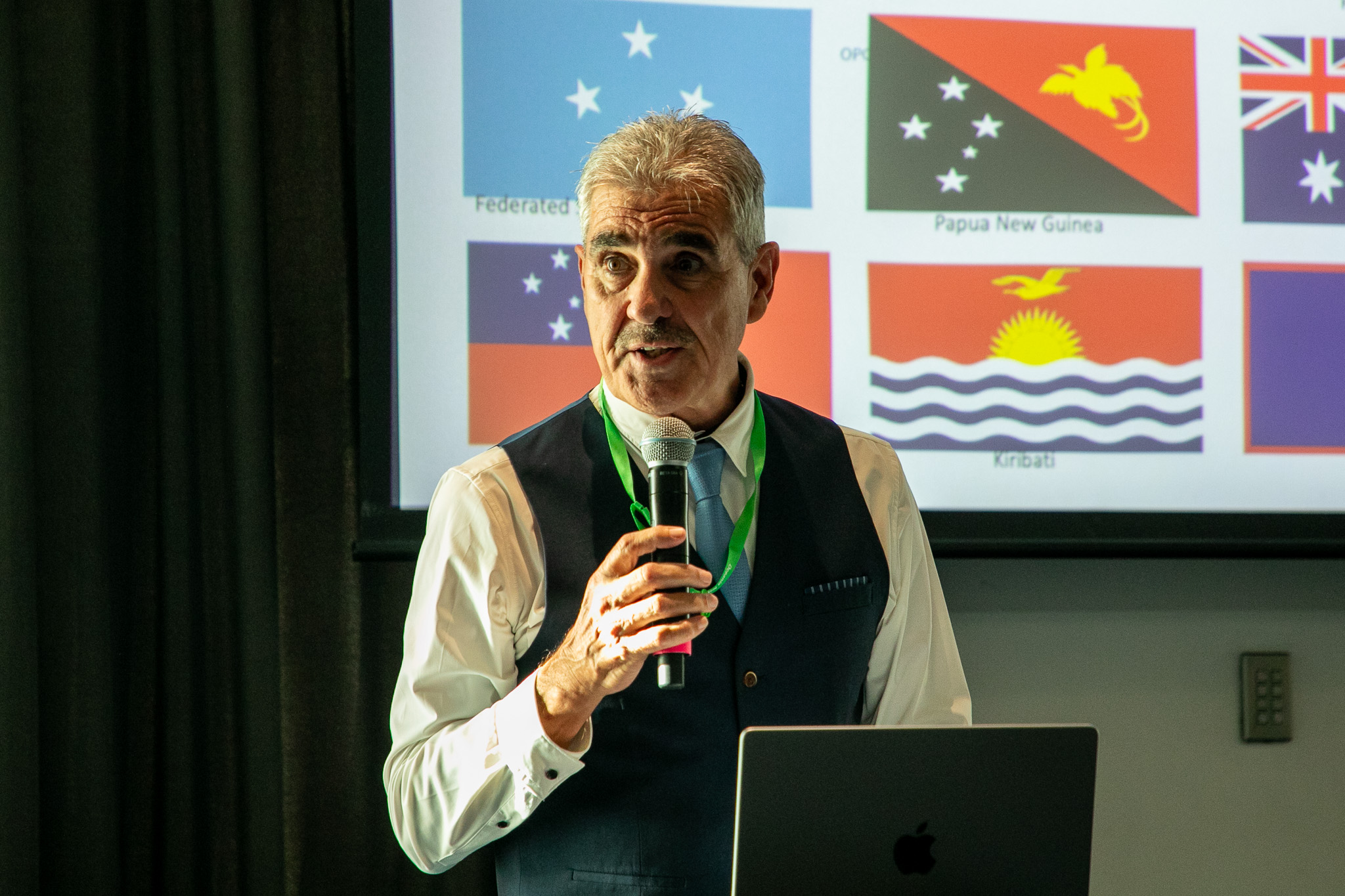
The Oceania Paralympic Committee opened day three of the 2026 ONOC XLVI AGA Week in Auckland, setting out a refreshed parasport strategy and a clear ambition of seventeen Oceania flags at the Brisbane 2032 Paralympic Games.
Auckland, New Zealand — 19 May 2026 · ONOC Media
The OPC Forum is one of only a handful of open sessions across AGA Week (17–23 May), positioning the OPC's strategic conversation at the front of the regional dialogue. It was chaired by OPC Board Member Alison Cray, with OPC President Paul Bird OAM PLY presenting the strategic update and Kate McLoughlin, Head of Games and International Engagement at Paralympics Australia, outlining the region's new classification roadmap.
“Our vision is to see an inclusive Oceania through parasport.” — Paul Bird OAM PLY, President, Oceania Paralympic Committee (OPC)
The OPC's refreshed strategy is built on four pillars — Participation, Pathways, High Performance and Classification — all underpinned by Governance, and is designed to reach all three impairment cohorts: physical, vision and intellectual. President Bird told delegates the Committee is progressing eight new National Paralympic Committees in the region, many of which are expected to integrate directly with their National Olympic Committees.
“How do we have your countries represented at the Brisbane 2032 Paralympic Games?” — Alison Cray, Board Member, Oceania Paralympic Committee (OPC)
Classification of athletes anchored the second half of the session. McLoughlin outlined an Oceania Classification Strategy developed with Inclusive Sport Design and supported by Department of Foreign Affairs and Trade, Australia (DFAT) seed funding. The proposed multi-year programme covers athlete travel grants, local classifier training, athlete education, and a dedicated Oceania Classification Manager embedded within the Australian high-performance system.
“We really hope it's the start of something really exciting to try and help you get seventeen flags to Brisbane 2032.” — Kate McLoughlin, Head of Games and International Engagement, Paralympics Australia
The open discussion that followed surfaced practical priorities for NOCs, including coach development, facility capacity, equipment costs and stronger engagement with national and Oceania regional federations as parasport delivery partners. Vanuatu's integrated NOC and NPC model was highlighted as a working regional example. International Federation representatives from VIRTUS, the International Blind Sports Federation (IBSA) and Deaf Sport Australia signalled complementary athlete pathways beyond the Paralympic programme.
In closing, the OPC confirmed each board member will be linked to an NOC to deepen day-to-day connection across the family. The standards, systems and partnerships built now will shape Oceania's representation at LA28, the 2027 Pacific Games in Tahiti and the journey to Brisbane 2032.
###
About ONOC
Established in 1981, the Oceania National Olympic Committees (ONOC) is one of five Continental Associations. It looks after the interests of 17 member nations in the Oceania Region, including Australia and New Zealand as well as seven associate members.
###
For more information, please contact;
Inoke Bainimarama, Executive Director
inoke@oceanianoc.org
###
Digital Channels
For up-to-the-minute information on ONOC and regular updates, please follow us on Facebook, Twitter, Instagram LinkedIn and YouTube.