Website Guide HERE

X
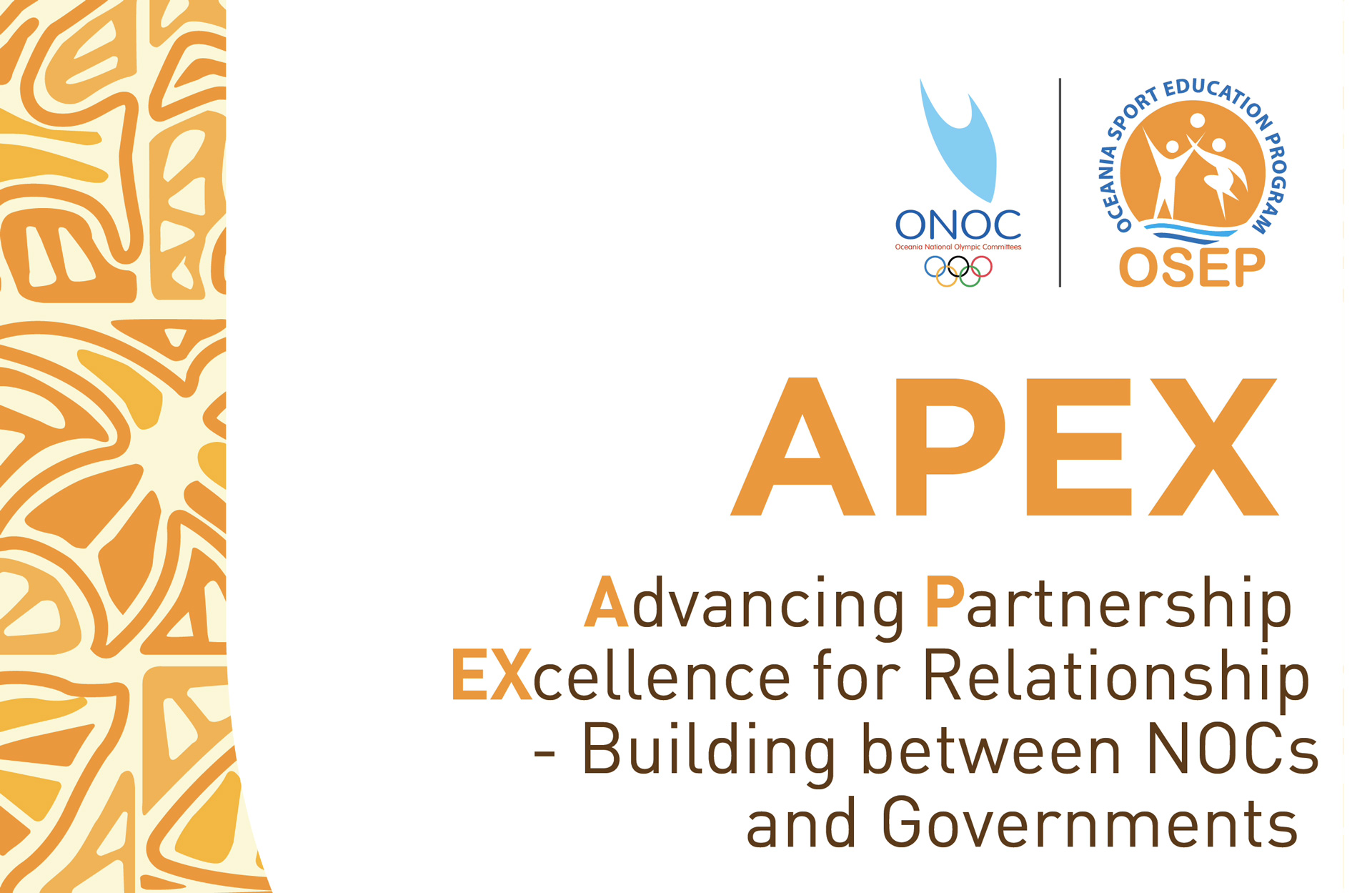
The Oceania National Olympic Committees (ONOC) presented the APEX Toolkit during the open session of the ONOC Workshop at the 2026 ONOC XLVI Annual General Assembly Week at the Hilton Auckland yesterday. APEX — Advancing Partnership Excellence — is a practical resource designed to strengthen relationships between National Olympic Committees and governments across Oceania.
The Toolkit was born from a clear recognition. Athletes cannot reach their full potential unless the institutions around them work well together. APEX responds directly to that need as the region prepares for a once-in-a-generation home Games.
“Relationship-building between NOCs and Governments is not optional; it is essential. It is the single most important factor that will determine how well our athletes, teams, and systems grow over the next decade.” Baklai Temengil, President, Oceania National Olympic Committees (ONOC)
APEX is an ONOC initiative developed through the Oceania Sport Education Programme (OSEP). It is evidence-based and shaped by direct consultation, with around 90 percent of Oceania NOCs contributing to the initial research. The work began as an Executive Masters research project at the University of Ottawa before evolving through stakeholder review into the toolkit shared at the Workshop.
The Toolkit is grounded in Principle 7 of the IOC’s Basic Universal Principles of Good Governance, which calls for a balance between the autonomy of sport and harmonious relations with government. It is built around five actions: reflect, clarify, identify, build, and adapt. It is also anchored in four Pacific values — respect, reciprocity, diversity, and working together for shared goals.
At its core is a practical assessment framework. NOCs and their government partners independently rate their partnership using a simple scoring scale, then come together in a facilitated Talanoa workshop to compare findings and agree a shared work plan. The Toolkit also offers an MOU template, a six-step partnership model, and a conflict resolution guide that each NOC can adapt to its own context.
“Real legacy is built through partnerships. Real partnerships are intentional, disciplined, and anchored in shared service.” Baklai Temengil, President, Oceania National Olympic Committees (ONOC)
ONOC invited an NOC and its government partner to pilot APEX as a regional case study, with the lessons to be documented, refined, and scaled across the region. The presentation closed with a call to action, and Fiji responded immediately by volunteering to take it up. Fiji’s commitment makes it the first to step forward. The timing is deliberate, with a seven-year pathway running from the Pacific Games in Tahiti 2027 to LA28, the Cook Islands 2029, Tonga 2031, and ultimately Brisbane 2032.
###
About ONOC
Established in 1981, the Oceania National Olympic Committees (ONOC) is one of five Continental Associations. It looks after the interests of 17 member nations in the Oceania Region, including Australia and New Zealand as well as seven associate members.
###
For more information, please contact;
Inoke Bainimarama, Executive Director
inoke@oceanianoc.org
###
Digital Channels
For up-to-the-minute information on ONOC and regular updates, please follow us on Facebook, Twitter, Instagram LinkedIn and YouTube.