Website Guide HERE

X
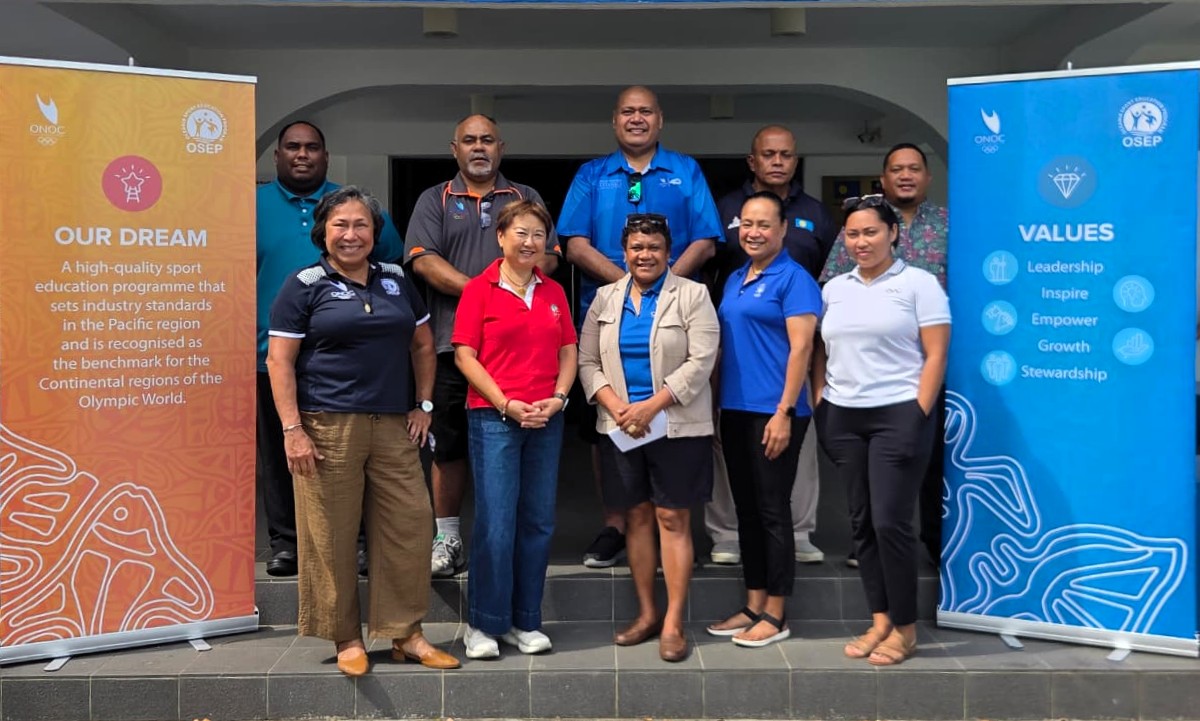
Chefs de Mission from four North Pacific National Olympic Committees have completed the OSEP Chef de Mission Course in Palau, leaving with strengthened Games Delivery Plans and a clear roadmap for the Olympic Games Los Angeles 2028.
KOROR, PALAU - Chefs de Mission from four North Pacific National Olympic Committees have concluded a four-day OSEP Chef de Mission Course in Palau, marking the first delivery of a longer LA28 Readiness Support Programme designed to move NOCs from awareness to operational readiness for the Olympic Games Los Angeles 2028.
Held from 10 to 14 August 2026 and hosted by the Palau National Olympic Committee, the course was delivered under the theme “Beyond the Course: Beginning the LA28 Readiness Journey” — a deliberate signal that the week was a starting point rather than a conclusion.
The course was officially opened on Tuesday 11 August by ONOC President Baklai Temengil, who welcomed participants in her dual capacity as President of ONOC and Secretary General of the Palau National Olympic Committee.
“This course is not the end of your learning. It is the beginning of your preparation for the Olympic Games Los Angeles 2028,” President Temengil told participants.
“The role of a Chef de Mission is one of great responsibility. You are entrusted with leading your delegation, safeguarding the interests and well-being of your athletes and officials, coordinating many moving parts, and representing your National Olympic Committee and your country with dignity.”
“At Games time, good leadership is seen not only in ceremonies or results, but in the quality of preparation completed months and years beforehand.”
Over four days, participants worked through the full operational picture of Games delivery. Day One addressed LA28 readiness, Chef de Mission leadership and a peer review of each NOC’s existing Games Delivery Plan. Day Two covered delegation planning and operational coordination, including accreditation, travel, accommodation, transport, uniforms, equipment, finance and logistics. Day Three focused on athlete services, safeguarding and risk management, incorporating medical support, communications, protocol and incident response exercises. The final day was devoted to plan finalisation, scenario-based validation and formal commitment to follow-up milestones.
Each NOC presented its summative work to peers and facilitators across the week, with daily outputs including a readiness assessment, an LA28 operational timeline and responsibility matrix, an NOC risk register and contingency plan, and a strengthened Games Delivery Plan supported by an agreed implementation roadmap.
The programme was led by OSEP mentors and facilitators Talemo Waqa and Nynette Sass, with LA28 Olympic Games Shared Services Lead Meli Cavu setting the strategic context on the opening morning.
President Temengil urged participants to treat the Games Delivery Plan as an operating document rather than a course assessment.
“It should become the living foundation of your NOC’s LA28 preparations. By the end of this week, you should know your priorities, the people responsible, the timelines that must be met, the risks that require action, and the support you need.”
“The strongest plan will not be the longest document. It will be the plan that is athlete-centred, realistic, understood by the whole team, and used consistently after you return home.”
The course reflects the ONOC Strategic Plan 2025–2028 and its vision of an empowered and innovative sport ecosystem in Oceania with athletes at the heart of sustainable success, alongside the RESET direction of OSEP, which emphasises stronger NOC ownership, capability, quality and sustainability.
The North Pacific NOCs are piloting the LA28 Readiness Support Programme, under which the mentoring relationship established this week will continue through Games Delivery Plan reviews, progress check-ins, problem-solving sessions, practical resources and a regional community of practice. Baseline assessments completed during the course will allow support to be targeted and progress measured over time.
President Temengil also pointed to ONOC’s newly established Games Commission as a further strengthening of regional Games support.
“The establishment of our new Games Commission provides a dedicated mechanism to bring together Games knowledge, planning experience and technical expertise across Oceania. It will help us coordinate support more effectively, capture and share lessons, identify common challenges early, and ensure that our NOCs and athlete entourages are better prepared — not only for LA28, but for future Pacific, Commonwealth and Olympic Games.”
“You are not expected to prepare for LA28 alone. At the same time, the responsibility for leading that preparation must remain firmly within each NOC. This is the balance at the heart of RESET: stronger NOC ownership, supported by regional expertise, peer learning, mentoring and quality assurance.”
Participants were asked to leave Palau with defined commitments for the next 30 days, 90 days, six months and 12 months.
“The North Pacific has always demonstrated resilience, ingenuity and a strong sense of community. When we combine them with disciplined planning, clear accountability and regional cooperation, our size and distance do not have to define our limitations,” President Temengil said.
“Together, we are not simply preparing delegations for LA28; we are building a lasting culture of Games excellence across our region.”
The South Pacific edition of the OSEP Chef de Mission Course will be delivered from 24 to 27 August 2026 for the region’s remaining National Olympic Committees.
###
About ONOC
Established in 1981, the Oceania National Olympic Committees (ONOC) is one of five Continental Associations. It looks after the interests of 17 member nations in the Oceania Region, including Australia and New Zealand as well as seven associate members.
###
For more information, please contact;
Inoke Bainimarama, Executive Director
inoke@oceanianoc.org
###
Digital Channels
For up-to-the-minute information on ONOC and regular updates, please follow us on Facebook, Twitter, Instagram LinkedIn and YouTube.